
Real Conversations, That You Need To Hear
We’re here to make sure you have the information you need to understand the major issues facing us as a country,
What We DoCivic Forum brings credentialed, nonpartisan experts directly into the communities that national media and national politics routinely skip over. We host live, public conversations on the issues that actually shape people's lives — wages, housing, healthcare, energy, the economy — and we ask the questions that don't get asked when the cameras are pointed the other way.
We're not here to tell you what to think, or which party has it right. We're to make sure the people with power don't get a free pass just because no one in your town was in a position to ask.
EVENTS
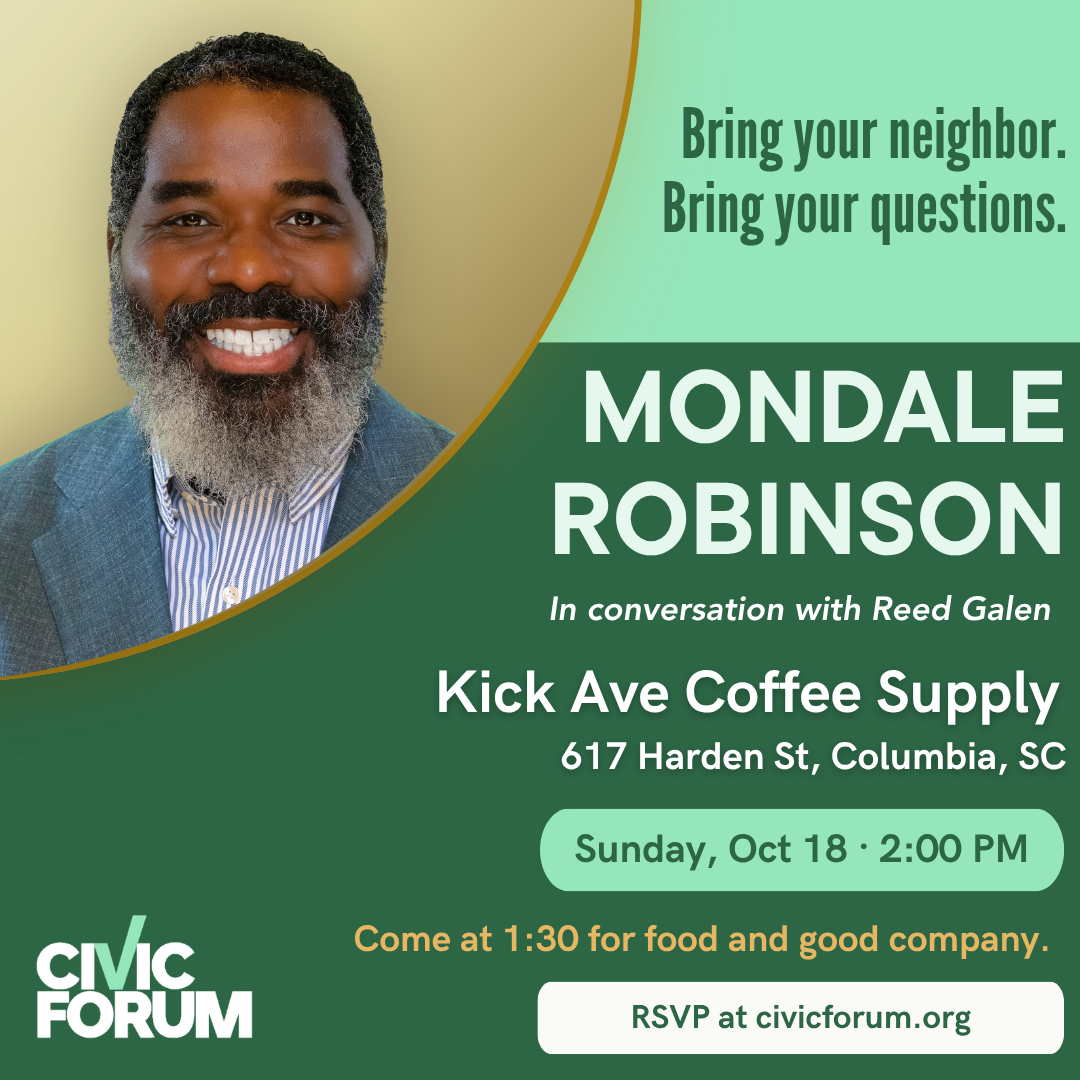
Sunday, October 18
Kick Ave Coffee Supply, Columbia, SC
Join Mondale Robinson, founder of the Black Male Voter Project, and Civic Forum host Reed Galen for a real conversation about democracy, community, and the South's next chapter.
Doors open at 1:30 with lunch and Kick Ave coffee on us. Bring your neighbor, bring your questions, and stick around afterward to meet the people working alongside you.
Free, but seats are limited.
The Gap We’re Closing
What's changed in the last 40 years?
Wages have stagnated, jobs have disappeared as the economy has shifted, and local newsrooms have closed by the hundreds — hitting hardest in the towns and small cities the national conversation rarely visits.
How big is the gap?
172 media markets sit outside the country's top 25 — home to 62% of U.S. voters.
Zero scaled, nonpartisan civic institutions have been built to serve them.
Why does it matter?
Civic knowledge shouldn't be rationed by zip code.
How We Think About It
We don't measure ourselves by likes or follower counts. Attention that doesn't turn into something durable evaporates as fast as it arrived.
So our work follows a simple discipline:
Say something worth hearing, consistently enough that people know where to find it.
Message
Build the local infrastructure — venues, moderators, partners, volunteers — before we need it.
Organize
Turn an audience into participants: a follow-up conversation, a volunteer shift, a local commitment.
Mobilize
Act
Do the unglamorous, continuous work. Civic capacity gets built one action at a time, not one viral moment.

Where We Stand
Civic Forum isn't red or blue. We're not interested in relitigating Party A versus Party B. We're interested in new ideas, new voices, and the questions that don't get asked enough. The ones that hold power to account no matter who's holding it. When we come to your town, we're not telling you what to think.
We're giving you better questions to ask, and we're not letting anyone off the hook for the answers.
Why Now
The vocabulary that shapes what's politically possible — on labor, on housing, on healthcare, on how the economy actually works for people outside a handful of zip codes — doesn't get built in national TV studios.
It gets built in libraries and high school auditoriums and county fairgrounds, years before anyone's watching.
That's where we start.
This Is What Civic Forum Looks Like
City by city, we're bringing tough questions into public view.

Next Events:
New York, New York
Manchester, New Hampshire
Sign up for details:
Who’s Behind It
Civic Forum was founded by Reed Galen, co-founder of the Lincoln Project and host of The Home Front podcast, out of a simple observation: the people best equipped to explain the forces shaping American life almost never talk directly to the Americans living through them. Civic Forum closes that distance, one city at a time.
What's In A Name?
Civic Forum (Občanské fórum)Civic Forum was the political movement that led Czechoslovakia's peaceful transition from communism during the Velvet Revolution of 1989. It was founded on November 19, 1989, at Prague's Činoherní klub theatre, two days after riot police violently broke up a student demonstration commemorating International Students' Day. Playwright and longtime dissident Václav Havel emerged as its leading figure and public voice.
The movement brought together a broad coalition: signatories of the human rights initiative Charter 77, student activists, actors, artists, intellectuals, and reform-minded citizens disillusioned with the regime. Operating from the Laterna Magika theatre, Civic Forum coordinated enormous demonstrations in Wenceslas Square and on Letná Plain, drawing hundreds of thousands of people. A nationwide two-hour general strike on November 27 showed that public support extended well beyond Prague's intellectual circles.
Civic Forum's demands were clear: the resignation of compromised communist leaders, the release of political prisoners, and free elections. Through negotiations with the government, it won rapid concessions. The Communist Party's constitutionally guaranteed leading role was abolished, a new government with a non-communist majority was formed, and on December 29, 1989, Havel was elected president. In Slovakia, its sister movement, Public Against Violence, played a parallel role.
Civic Forum won decisively in the June 1990 elections, the first free vote in over four decades. As a broad umbrella movement, however, it struggled to hold together once its central goal was achieved. In 1991 it split into distinct parties, most notably Václav Klaus's Civic Democratic Party and the Civic Movement, but its legacy as the engine of nonviolent democratic change endures.